Showing posts with label disability. Show all posts

Tuesday, August 18, 2026

A pain in the neck: The odyssey for decent, comfortable IMAX ADA seats

Last week my friends and I went to the show. When the movie let out, the lobby was swamped with people. They were lined up everywhere. At five in the afternoon, on a Monday. It took a while to pick our way through to the exit.

All these folks had turned out to see two of summer’s biggest blockbusters, Spider-Man: Brand New Day and The Odyssey. Both are screening in IMAX. The Odyssey director Christopher Nolan encouraged viewers to catch his new movie in IMAX to get the full effect of his work. He’d worked with engineers to come up with better, lighter cameras allowed him to shoot his entire 3-hour feature film in IMAX format, which was about impossible to do before. Add to this that there are only 25 theater-screens in the country that can project in the ultimate experience, IMAX 70 millimeter, and the only one in Chicagoland, which is this theater we attended — so moviegoers are making the trek across the metro area and the state of Illinois and even from other states to this one theater, and to this one theater’s lobby. But here is one of history’s biggest stories, shot in a huge way by a huge director, so people are there in search of a unique, unforgettable experience.

How my neck felt after my first IMAX movie.

Unless you’re a wheelchair user, that is. Because if you are, then this could be an unforgettable experience for how utterly disappointing it was. In some IMAX theaters, the patrons who use wheelchairs were an afterthought, which was my own and only IMAX experience, long ago. These are the IMAX theaters where the ADA seats are right in front of the towering screen, or like mine, crammed in at one side or the other. I remember less about the movie shown and more about my neck craning the entire time. In a situation like that you are not even able to take in the whole picture, and you’re literally not in any position to enjoy it. The poor seating made the movie uncomfortable and uninteresting, as in I couldn’t wait for it to be over.

Still, if possible I really wanted to see this flick with the special IMAX sauce, so at the website I checked the seating diagram. I wasn’t confident about what I was seeing. The thing to do at this point would be to call the manager and arrange a look-see before buying tickets. But no, I’m jumping through extra hoops every day of the week because that’s what we’ve got to do, right, but enough already. It’s show time and I’m damned hooped out. So, I reserved for the standard format screening with guaranteed midhouse ADA seating for me.

If it helps anyone out there, Copilot AI suggested we might find better ADA seating at IMAX theaters built in 2015 or later, and at theaters advertising “IMAX with laser,” both of which offer more mindful, more equitable design. It sounds like the earlier generation of theaters may be the spine-bending offenders. Useful information to know, if Nolan’s IMAX cameras take off in the industry, in search of The Odyssey-like box office riches.

In the end, it didn’t matter what format I chose, I was disappointed in The Odyssey. The Nolan movies I’ve seen I liked, ranging from adrenaline-stoking thrill-rides to spine-tingling weirdness. This one had none of those qualities. To me, it was just crap storytelling: boring, confusing and ponderous. Which is a shame because Homer was literally a storyteller, not a writer. He recited stories to others, like a bard, and a disabled bard at that.


Thursday, August 6, 2026

A Taste of the Future? Reviewing Augmental’s MouthPad^ Wearable Controller

Through a combination of frugality and needs, I long ago landed on a combination of speech recognition and a mouthstick to do my writing and editorial work. But as a C4 quadriplegic with multiple sclerosis, and growing older, my seating and positioning are growing more precarious. I wanted options that might free me from some of the physical contortions and frustrations that have long been part of my work setup. After using the same computer accessibility setup for about 30 years, I recently decided it was time for a change.

Having read about Augmental’s MouthPad^, a custom-made wearable controller that looks and fits like a dental retainer, I was excited to try it out. I expected a novel tool that was somewhat of an upgrade from the speech-driven mousegrid/voice control navigation I’ve been using half my life. What I got was a genuinely exciting experience and an instrument I believe I’ll continue to master and explore with. 


Multitasking with my MouthPad

The MouthPad^ has an embedded touchpad that you use with your tongue, but the device also recognizes other easy inputs like head motions, sip and puff, and bites. Through Bluetooth and an accompanying app, it can control devices that run more recent versions of Windows, iOS and MacOS. It helps control Android devices too, in a more limited way.


I found the device to be extremely mobile, discreet ("Ah, sweet privacy!" says the decades-long speech recognition user), and versatile with its many features. Funding and product-life are two concerns, but vocational rehab often does fund the device and there are other financial sources available.

It gives me better control of my device, like when a phone call comes in while I'm working, I'm instantly able to pause work, switch off speech recognition and answer the call long before it goes to voicemail. A big improvement for me.

Finally, it is fast. Many of my most basic activities, like editing; navigating between files and programs; or working my way around websites, go much quicker. To me, that's not just a convenience. So much of my disabled life is about losing time: the waiting, the slower pace, the obstacles, the need to do things more than once. When I can move quickly, it’s exhilarating, it's empowering. The MouthPad^ lets me to do this.

Check out my full review in New Mobility for details. The future for disability users tastes spicy, and I like spicy.

Saturday, June 28, 2025

Disabled Texas Woman May Lose Coverage and Home From Medicare Cuts

“I've worked hard. I'm to the point where I own my own house,” says Nancy Crowther, 67, of Austin, Texas. “I have [attendant] services, and to lose that would be to lose my livelihood and to be desperately placed in an assisted living or something.”

Although she has spinal muscular atrophy, a progressive muscular disease with no cure, Crowther remains socially active and fiercely independent. She’s thrived for years beyond everyone’s expectations, she says, and chalks it up to her Medicaid home-care attendants, who help with daily necessities she cannot do on her own — and which she risks losing if Congress passes historically large cuts of $625 billion from Medicaid. The Senate is working through the weekend to pass its version of the spending bill in order to meet Pres. Trump’s stated goal of signing it into law by July 4.

Crowther is one of 70 million covered by Medicaid, and she’s also someone who has publicly told her story for decades to help score wins for the Texas disability community and the attendants who care for them. Now that the U.S. House passed its bill that would cut 13.7 million off of health insurance, Crowther is using her voice to call senators to tell them what Medicaid does for her — and urging others to join her.


(Above, radio version of story, from The People's News, KPFT-FM Houston, May 22, 2025.)

“{Medicaid] involves so many programs for young, for old, for different types of disabilities. It’s just a multiuse tool and if you start losing pieces of that tool, that's part of your independence that you’re losing,” she says. “Our lawmakers don't even understand that.”

Medicaid is the primary funder for home- and community-based services to keep seniors and people with disabilities living in their own homes with families and caregivers, instead of in institutional care like nursing homes that are more costly to taxpayers. These popular attendant-care programs already have waiting lists for enrollees in states across the country, and with current plans to shift Medicaid costs away from the federal government onto the states, with fewer resources, “usually, historically, the first [programs] on the chopping block are those home- and community-based services,” according to Jason Resendez of the nonprofit National Alliance for Caregiving. Losing her independence this way would be Crowther’s worst-case scenario. “The lowest thing on the totem pole would have to be an institution,” she says. “That would just be the death nail.”

In the House bill, the savings only partially fund $3.7 billion in tax cuts, the largest share of which going to those with the highest 10% of income. The bill would add $2.4 trillion to the national debt, not counting adding interest on that debt.

Crowther discovered the power of her voice years before the Americans with Disabilities Act, in the 1980s. She got involved in the movement to make Austin public transit accessible not only for people with disabilities, but also seniors and families with strollers. Since then, she’s been awarded for her groundbreaking work and has continued speaking out across her state of Texas, sometimes sharing her personal story with policymakers, or being the only disability perspective present at a meeting or serving on an advisory board.

Crowther was part of the push that moved the Texas legislature to boost wages for attendants who care for the disabled and seniors in 2023. Last month, members of her group, ADAPT-Texas, were among 300 wheelchairs users and supporters who packed the U.S. Capitol. Twenty-seven were arrested for bringing a House committee hearing to a halt, demanding they not touch Medicaid. This week, Crowther encourages fellow Texans to call their U.S. senators and relate their own stories and those of families and friends to whom Medicaid is important.

“It really fills you up with a sense of boldness, strength and compassion because you've done what was right,” she says. “And, you know, when people complain about things, I just look at them, like, ‘And what have you done about it?’ Not to be mean, but I've got to put it back in their hands.”

To reach senators’ and representatives’ offices, call the U.S. Capitol Switchboard at (202) 224-3121.


Saturday, April 5, 2025

A view on disability leave that you probably haven't seen before

On the MS Society's Momentum blog, I write that disability leave is usually very helpful, yet it's a two-sided coin:

I remember the quiet, so pristine I wished I could bottle it. It was my first week on Social Security Disability Insurance (SSDI). I couldn’t believe I didn’t have to go in to work: No more taking 3 hours to get ready, then driving 45 minutes downtown, parking and struggling to reach my desk on the 14th floor in time. I didn’t have to do any of that, only heal. My apartment was so silent and still that the air was almost ringing.

It was heavenly.

Fast forward a few years. I got up to start my day and begin the long process of pills, washing, dressing and breakfast. My apartment was so silent and still that the air was almost ringing.

And it was driving me freaking insane!


It surprises me that I've never seen another writer saying this: that going on disability was a lifesaving opportunity for me, but the comeback effects in terms of social isolation, depression and more, brought serious consequences for me. I'd definitely like hearing from any others who had experiences like this. 

I encourage you to go for a better life on disability ... but keep your eyes peeled for both sides of the coin. 


Sunday, March 2, 2025

Disinvited to the party: A new administration means new challenges to people with disabilities

Seeing the president quickly claiming that disabled workers and diversity, equity and inclusion programs played a part in the fatal Jan. 29 Washington D.C. air collision, when investigations were barely underway and no one knew anything for sure, was certainly a batten-down-the-hatches moment. Especially when it was soon apparent that there is a long record of close calls between military and civilian air traffic in that area, and even now the NTSB is looking at several possible causes including equipment malfunction that may have led the military aircraft to fly too high in the air space. Yet the knee-jerk response was to go after people with disabilities. Then, it’s not surprising from someone who publicly mocks the disabled for a laugh line.


Obviously DEI is this season’s political bogeyman. However, there are practical reasons why DEI programs came about. Yesterday I learned about a paraplegic who works for the government developing emergency response protocols to cover people with disabilities, because who is going to know how to handle the needs of people with disabilities better than other people with disabilities? And since professionals in the field want to better their knowledge, they actually want to learn how to best help people with disabilities from people with disabilities. Does that follow? It’s hardly a nefarious scheme. Many times I have been asked, as someone who is disabled, for ideas on how to set things up in ways that are better for people with disabilities, from architectural details to technology questions and even the shapes of tables. This week I was hired for a job because they need someone who has experience with disability because some of their clientele have disabilities. I hadn’t thought of it until now, but I guess that makes me a “DEI hire.” Egad. I feel so dirty.

What’s interesting is seeing how quickly the broad-based corporate support for DEI fell like a tree, affecting not only the disabled and minorities but women too. But I understand that corporate America doesn’t want a fight with authorities — it wants stability and predictability, and so its support was always as thin as a dollar bill. Take note of that time you see a commercial tugging at your heartstrings about how much the advertiser cares about you. But it’s also wrong for me to paint with too broad a brush, when plenty of big names are standing behind their principles, like Apple, JPMorganChase, Delta Airlines, John Deere, Costco, Ben & Jerry’s and e.l.f. Cosmetics.

Add in that Medicaid — a major insurer of the disabled and the guarantor of services that keep people living in their own homes instead of (and for cheaper than) nursing homes — is a likely target for cuts after the U.S. House of Representatives passed a budget resolution this week calling for a massive $2 trillion in cuts.

Also, Section 504 of the Rehabilitation Act of 1977, a major piece of accessibility law that led to the Americans with Disability Act, is being challenged by the attorneys general of 17 states. Some of those bringing the suit claim that the challenge is limited to recently amended parts of the law that cover transgender people, but the language of the suit specifically targets the entire accessibility law.

Taken together, the disability community is definitely on edge. Rather than sit and squirm over the news though, long-time disability advocacy leader Bob Kafka’s advice is “don’t mourn — organize.” For instance, the House would have to go through many steps before any proposed Medicaid cuts would become a reality, so it’s a good time begin calling your rep (Capitol Switchboard 202-224-3121) and let them know what you think about how they voted this week and how Medicaid cuts would affect you or those you know. You can likewise chime in on the Section 504 case and tell your attorney general how important accessibility is to you, the voter. These policies and provisions were hard won, and once they’re diminished or gone, they’ll be extremely hard to claw back.

Saturday, February 1, 2025

World Gone Sideways: Bedsore Recovery Turns Life Topsy-Tervy

I ruptured my hull.

I done sprung a pressure sore down there, on my business end. Actually not a pressure sore, it’s a pressure “sort of”: started with a tiny cut, a fissure in the skin. When we found it I stayed in bed the whole next day, that’s how seriously I took it, and in the morning it looked safe to sail again. I kept my sails trimmed, lying back frequently in my wheelchair to take pressure off, and everything was cool.

But the next morning, we were taking on water. The split had splat. The cut had widened into … well, you don’t need the details. But now it was a thing, with its own address. It had set up shop.


For a wheelchair user this is a code red. We do our best work on our asses. Some of us even are asses. Getting a wound there would be something like a nondisabled person stepping on a nail or broken bottle, except a wheelchair user doesn’t have a second, uninjured ass he can still get around on with a crutch for a couple of weeks.

Unless you’re lucky, these things heal slow, so I’ve been in bed since last week. Once I spent the better part of a summer in bed, biding my time. When I finally made my way out of the house in late August, the bluest sky in history was out there waiting for me, blUing its ever-lovin’ top off, right above my head. Heavenly days!

But back to the here and now. In true Texas fashion, where we go bigger and more catastrophic than anyplace else, my lovely wife tripped while she was walking the critter, and landed hard on her shoulder. The urgent care center said nothing had broken or ruptured, so she’s been going around doing everything, including the caregiving, with one arm. Baby’s still got chops, but does em at half-speed.

Capsized  

A couple of weeks in, we’re generally on the mend but it’s slow going. Mary Anne is the quickest of studies, learning how to do everything one-handed, and taking more breaks through the day. She has new respect for our friend Judy, who was born with half an arm. “How ever does she put on her bra?” Judy loved that.

I am lying on my side now writing you this. And we can't get the laptop computer to lie at the same angle as my face, so it's … weird. My world is tilted, like the bad guys' hideouts in the Batman TV show.

Mary Anne made some fried rice, zapped up with sambal oelek pepper paste from Indonesia. Sitting on a stool, she feeds us the spicy rice as I lie capsized in bed. It’s at once pathetic and more romantic than our first date together, which was 35 years and 10 days ago.

But we’ll survive and rise again, like we’ve done before, then, down the line, stumble into another breakdown, so that we can rise again from that one. The waves they go up and down, but always they carry us forward. Anchors aweigh.

Thursday, January 23, 2025

MS anti-inflammation and improvement from a cheap, safe OTC supplement we all know?

Studies show that oral N-acetylglucosamine produced benefits for remitting-relapsing, primary progressive and secondary progressive types of MS. After one month, nearly one-third of subjects reported less disability. No serious side effects were seen even after supplementing for long periods of time. As of last summer, the National Institutes of Health was continuing to study it, but as lead researcher Dr. Michael Demetriou of University of California Irvine School of Medicine points out, "Anyone can get their hands on [it now] if they have $20."

And that’s just what I’ve done, except that it was $17.99 — for potential MS anti-inflammation and symptom improvement.


I don’t know how many out there are like me, but I’m without an MS treatment. With primary progressive MS like mine, there are few disease-modifying drugs available. The DMT most prescribed for PPMS is Ocrevus, but my neurologist, who was one of the researchers that helped to get the drug approved, strongly warned me away from it because of the risk of respiratory infections that I, as a full-time wheelchair user, may not be able to fight off. So while the MS Society recommends that everyone with MS should be on a DMT, I haven’t been on one for years. At this point my case is only very gradually worsening, but I don’t know how much more spinal cord I have left before I develop breathing and swallowing problems or more.

Then, instead of just playing defense with symptom management alone, I’m been open to looking at promising research-study results. Nothing crazy. I stick to NIH-related stuff. One of my past neuros, who had MS himself, pointed me to a study about intermittent fasting, which I read and, yes, gave a try for a few months. It wasn’t for me, but I tried.

Another, I still stick to. Overcoming Multiple Sclerosis is a program started by Dr. George Jelinek in Australia, who has MS and went through the scientific literature of the time to come up with his protocol. It’s a number of lifestyle changes, like exercise, meditation, minimizing stress and taking daily omega-3 fatty acids in the form of flaxseed oil. The most difficult step for most would be the largely plant-based whole foods diet, except for allowing various cold-water fish — so really it’s a pescatarian diet. The thinking behind it is to minimize saturated fats, which according to the work of influential doctors Swank and McDougall, contribute to the most rapid MS deterioration. I tried going the extra step of cutting out meat altogether, since I was 95% of the way there already, and I did fine with it, and have been vegan now for about a dozen years.

There are no miraculous cures anywhere on this page. OMS is about maximizing your well-being while living with MS, including using DMT’S, Jelinek writes.

Still, taking glucosamine — make sure it’s oral N-acetylglucosamine for best results — which is available for cheap at your local anywhere store, to maybe get both anti-inflammation and improvement? With little or no side effects? Tantalizing, yes?

Related articles:

https://jneuroinflammation.biomedcentral.com/articles/10.1186/s12974-023-02893-9

https://www.webmd.com/multiple-sclerosis/news/20240710/could-help-be-coming-for-progressive-multiple-sclerosis

https://multiplesclerosisnewstoday.com/news-posts/2023/09/19/sugar-molecule-supplements-glcnac-may-ease-inflammation-ms-trial/

https://www.ucihealth.org/news/2024/07/progressive-multiple-sclerosis

https://tinyurl.com/baj4ejzb

https://multiplesclerosisnewstoday.com/news-posts/2020/10/09/simple-sugar-molecule-may-be-potential-myelin-repairing-therapy-multiple-sclerosis-mouse-study/

Tuesday, October 1, 2024

Newly diagnosed "can truly be optimistic about their prospects for a life free from disability"

Years ago I was skeptical of all articles like the one I'm highlighting below. I'd see them regularly -- 'The New Drug on the Way Could Be a Game-Changer' or 'A Cure May Be In Sight,' stuff like that -- I mean, how many times can you hear them cry wolf? Particularly when you have primary progressive and there were no treatments at all. But now there is so much going on, and the post-pandemic science has moved the sticks so much. … The landscape feels much different to me now. It doesn't smell like BS anymore. (How's that for unscientific?) Even if there still isn't a treatment for me. Here's to someday. --


Dr. Stephen Hauser, who has been working on MS for decades, is hopeful that the world is on the cusp of a new era in MS. “The battle is not yet won, but all of the pieces are in place to soon reach the finish line — a cure for MS. … I think we can, in the next few years, completely suppress the disease in most people, if the proverbial tea leaves continue to point in the direction that they do today,” he said. And a cure for MS could be close behind.

And in the last decade, UCSF researchers have made incredible advances that could, one day, reverse MS symptoms or even treat the disease before it begins.

Today, clinical studies like those being conducted by the UCSF Weill Institute for Neurosciences, which Hauser directs, are investigating new ways to aggressively treat MS sooner with existing medications and new, more powerful versions. They are also concentrating on myelin repair. The Institute is applying lessons learned from MS to develop treatments for degenerative brain disorders like Alzheimer’s and Parkinson’s, as well as ALS (amyotrophic lateral sclerosis).

Excerpts from full article: "A Cure for Multiple Sclerosis? Scientists Say Within Our Lifetime."

Monday, September 16, 2024

Make your plan to vote! Sign up for tomorrow's MS Society voting webinar.

For health care and insurance, disability policy and medical research, this will be a big election. Whoever you plan to vote for, it's important to know the "how" — because every state has different voting and registration laws.

On Tues., Sept. 17 at 2 PM ET/ 1 PM CT/ Noon MT / 11 AM PT, voting expert Michelle Bishop of the National Disability Rights Network gives you info and answers questions to help you form your own voting plan. Sign up and make sure you have your say!

https://p2a.co/21fsGql


Saturday, August 13, 2022

The Parking Placard (Black n') Blues

How I Learned to Stop Worrying and Love the ADA, Which Just Turned 32

It’s an epiphany when you realize for the first time that the white stick-figure on the blue parking sign is you. That's you. Now you can park in that fat sirloin of a spot. Now you are “the disabled.”

For me, this leap to disabilityhood was as every bit as much a mental process as a physical one. And I fought the knowledge, down the line, tooth and nail. I always did, with every new adaptation or assistive device, fight, fight, fight. To some that sounds courageous, but really it’s ridiculous. But I was young, I was always healthy, and I was a guy. I didn't need no parking placard: that's for other people. I didn't need nothing. 

I had a thick head. 

Something new, something blue.

So what changed my mind? I can’t remember the moment I decided to pick up a disability parking application. It must have been some watershed event, perhaps my 1,000th fall, the one that rattles your very teeth. Falling itself was no big deal, and I might do it a half dozen times in a day. After a while, my body looked like Keith Richards’ after a bender, but cry-cry, I dusted myself off and got back in the game – because you've got to, nobody's going to pay your way. But maybe that 1,000th time was the one to slosh my brain in its comfy bath of cerebrospinal fluid: Wake up, you green-gray piece of fat!

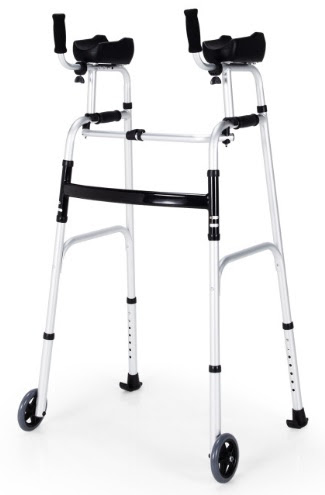
I used a walker then. An aluminum walker, to go along with my biker jacket. I would drag the thing to the grocery store for a few items, forgetting half of them by the time I reached the aisles. No browsing, no price-shopping, I just toppled things into the basket, teetering in the checkout while I fished for money, and dragging my Frankenstein feet out to the parking lot again, cars politely navigating around me - although the occasional Einstein would honk, not that I could turn around to see him, not that I could reach around to flick him off.

Muh sexy ride.

As my legs exhausted themselves, each step became smaller, smaller, until my energy was drained and my limbs locked like jointless boards due to muscle tone. In the middle of the parking lot, I stood stock still, like performance art, like the Tin Woodsman in the days before Dorothy Gale. 

To make things a little easier, the walker had wheels on the front legs so I could shove it along instead of lifting and planting it on every step. But once fatigued, I lost the power to hold the walker in place, and the wheels assumed a more insidious role, creeping forward slowly. As they gained momentum, I thought, No, no, this can't be happening. Unable to lift my feet, my upright posture deteriorated into a wider and wider triangle as the walker rolled further away. As my angle increased, I could hear Carly Simon singing “Anticipation.” I couldn’t let go to break my fall - my hands were locked - so I'd take a deep breath and bail, turning my face as best I could, because I don’t need to be any uglier.

On the way down, I’d think: Don't land on the Chef Boyardee!

This happened once on a frigid winter night, after my friend and I had attended a wake and on the way home, stopped for a nightcap. The parking lot was a thin, solid sheet of ice. I straggled back to my car, up a slight incline of drainage built into the black asphalt. Along the way I had to stop and rest, talking to my patiently shivering friend while we waited for my chilly legs to unlock.

I detected motion. Yep, I was sliding backward over the ice, in the direction of the drain. I was unable to move or resist; like a Gemini astronaut, I was only along for the ride. At the time I had no idea where I was going: I wasn't even facing the direction I was headed.

My buddy circled nervously around me. “Hey, Fred Astaire, what do I do?”

I was picking up speed. So I had to be honest with the guy. “I got nothing."

Jim dug in behind me to brace me, but honestly, in our leather-soled dress shoes, we might as well have been in ice skates. At this point I think he was pushing back simply to save his own hide. But there was nothing he could do; there was nothing anyone could do. We were a runaway train, and I was taking him down with me.

I sometimes imagine what it was like for someone in the warm comfort of their car to watch us gliiiide across that parking lot. Floating, gracefully rotating in space. Maybe the Blue Danube Waltz was playing on their radio, <CUED UP FOR YOUR LISTENING PLEASURE> 

while we skated from one side of their windshield, all the way across to the other side of the windshield. … Faster and faster… Have you watched curling in the winter Olympics?… 

On and on and on… Circling the drain...

What would become of our intrepid boys?

That’s when I started laughing. In uncontrollable circumstances, laughing is often the best thing to do. In Chicago when freezing your body parts off we often laugh it off with our friends. Because it's better to freeze body parts off together and be laughing, then it is to freeze body parts off and not be laughing. And that's the science behind that.

But also, convulsive laughter is useful in defeating spasticity. In an instant, we were a giggling heap of metal and man sprawled on the dark ice. In our slick shoes, we'd be stranded on that parking lot for some time. For the life of me, I can't figure out how we ever got up again.

Lucky were the times when there was a friend around and frictionless ice to fall on. More often, it was a sidewalk or bathroom or busy street crosswalk, hopefully with one or more gallant onlookers there to drag me out of danger and stuff me in my car. After I’d rebuff their offers for medical help, I would fall asleep on the front seat, sometimes for over an hour, sometimes with the engine running.

Somewhere in there happened magic No. 1000, the one to knock some sense in my noggin, the one to make my broken capillaries cry out, “Get the blue placard, already!”

Before then, I clung to a strange, outmoded idea of what independence is. But once I crossed that thin blue sign, what I found was a fuller independence of accessible jobs, housing, education and protected rights, accessible medicine and tech and yes, even decent curb cutouts and parking spaces - a whole societal push to involve everyone, to bring everybody to the decision-making table, even hardheaded fools who happened to fall upon the right decision one day, after he fell absolutely every other place first.

Viva the ADA.

Wednesday, February 9, 2022

Frida Kahlo, Disability Artist

        Here's one from my queue that somehow never got posted. It's always a good day for an art post, and color during the endless sludge of winter, and Frida Kahlo...

        "I paint self-portraits because I am alone so often... I am the person I know the best."

At the Frida Kahlo: Timeless exhibit that closed last week at College of DuPage's McAninch Arts Center in Glen Ellyn, Illinois, what gripped me as much as her artwork, 26 paintings, was how profoundly her life and art were shaped by disability. I knew from the biopic with Selma Hayek that she led a life of physical pain, but had l no idea she was bedbound so often and so long that she created a lot of her great art there. The exhibit even placed a replica of her bed right in the exhibit!


At age 6, Kahlo contracted polio that left one leg shorter than the other. At 18 she survived the crash of a bus with a streetcar that killed several passengers. Kahlo was pierced by a metal handrail that fractured her pelvis and punctured her abdomen and uterus. Her spine was broken in three places, her right leg in 11, her collarbone was broken and her shoulder dislocated. That fateful moment dealt her a lifetime of agony, isolation and miscarriages, but also tempered her artistic vision and the resolve to realize it no matter what.

At times she saw herself and others in an almost disembodied way. She created surrealist paintings that looked like medical charts of her miscarriages, vehicular accidents, and the metal rods that propped up her back and caused chronic pain. She turned that same almost clinical eye on her portrait subjects and on the way women are treated. One of the paintings shows the brutality a woman from the headlines had suffered at the hands of a murdering man, and Kahlo pulled no punches on the details, making sure viewers got an eyeful of how many women are treated. But on the other hand, her eye could capture the lace as fine as dewdrops on the sleeve of an otherwise poor and plain-looking young girl whom she painted, signaling the beauty she saw inside of her young friend.


The exhibit highlighted the disability theme throughout the exhibit, and amplified the message by mounting a side gallery of works by Tres Fridas, a collective of artists Reveca Torres, Mariam Paré and Tara Ahern. Tres Fridas (the name is a nod to Kahlo's painting, Dos Fridas) stage disability-related recreations of famous paintings. The nameplates of their works show the original artworks to compare with, as well as explain issues that people with disabilities are dealing with today. Kudos to the McAninch Center for taking this opportunity to underline important issues that the general public gets little exposure to.

Kahlo embraced her own disability as an intrinsic part of her whole self. She wore support braces around her torso, three of which were re-created for the exhibit. One was of burnished leather that resembled a hunting vest or leather armor. Another was moulded plaster, decorated with exotic painted flowers and designs. Another way that disability was manifest in her art was in her subjects, especially herself. As a young woman (she died at 47), her energies and mind engaged with the wider world, yet for much of life her body would not let her. She and her famous and influential husband, the painter and muralist Diego Rivera, reveled in the company of artists and thinkers in Mexico and worldwide. One item in the exhibit is a short film showing her and Riviera with the historic revolutionary Leon Trotsky after he came to Mexico in exile from Russia. (Soviet Premier Joseph Stalin would send an assassin to kill him shortly afterward.) All this, and still Kahlo led much of her life in her bedroom, alone.


And yet, even forced to lie on her back, she created art. To create requires willpower even for someone able-bodied. That she continued to do so through pain and depression is a testament to her power as a person and artist. As I deal with similar issues, she amazes me.


Of course Frida Kahlo is not only a disability artist. She was also painter, provocateur, fashionista and proud mexicana (in the Mexican Revolution of 1910, Mexico threw off the yoke of dictatorship, and society of Kahlo's day embraced and celebrated its native culture and history): all of these things made up Frida Kahlo as a person and as a life, and she incorporated it all into her art and expression. Even her disability and isolation were not overlooked or kept hidden: they were turned into a source of power that made her work unique, that is, uniquely Frida Kahlo. (Until recently, disability and depression were forbidden subjects. Now think about the taboos back in Kahlo's time!) Things like these seem like common sense, and yet we (me) sometimes have to learn basic truths like this, and it can take a great artist and museum to help us understand.

Viva Frida Kahlo!


Tuesday, May 4, 2021

"Opening the world, one disability story at a time" – KPFT FM Houston Peoples News

This year's Oscars showed that disability stories and issues are strongly in the public eye. And that's the mission of a group that's moving the needle of awareness, one story at a time. I talked to Celia Hughes of Art Spark Texas about Opening Minds Opening Doors, a program helping anyone, anywhere tell their own story and open people's minds. 


#ArtSparkTx #multiplesclerosis #advocacy #disability #omod #storytelling

Sunday, March 14, 2021

A Guy and His Guitar - "Rock n Roll n Mangled Spinal Cords"

With a chronic illness, you have to focus not on what you can't do -- but what you can...

You've got this one life and time's ticking...

You're a fool if you just sit in your own shite all the time and don't look up at the sky...

Just because things didn't go the way you planned, guess what? It doesn't go according to plan for anybody else either...

That was a column I was reading, words to that effect.

Ah, shaddup! is what I was thinking.

Which is funny because the column in so many words summed up my approach to MS. I mean, I don't say things like that to others, but the self-talk in my head cycles through things like that all the time. But sometimes you don't want to hear the spiel, right? Not even if it's your own.

I kept reading though, because it was written well and I was almost through it. And it turned out to be a good piece, because before I got to the end it had sent my mind off spinning in its own direction, like what a good book will do to you. The author said not to focus on the things you've lost, but the things you've gained. Which makes for tricky math. You've got a lot of things on the one side, and not as many on the other. Do they balance out? Only if the things gained are a lot bigger, more substantial. Disability toughens you: plus. It makes you more resourseful: plus. I guess in a weird way, disability brought me my wife, because neither one of us was in it to get married. Our attitude toward marriage was more like, 'Ick.' But things changed, kind of fast, which is a whole other story. Bottom line, I got the girl, even if I had to get disabled to do it. Jackpot. Gotta do what you gotta do.

But while reading that column about losing things, images flashed through my mind. One of the first was giving away my guitar. A guy loves his guitar. We were literally attached at the hip for a dozen years. I walked around with it everywhere. It was a black '84 Fender Stratocaster, and it was all mine. But my fingers eventually were no longer mine. I loved playing but was never wizard, and yet my playing grew sloppier still. A lot of playing is muscle memory: practice practice practice and you'll play better and faster. But I was going the opposite direction. My fingers were unlearning songs. In the middle of jams, the guitar pick shot out of my hands like a bullet. There came a time when the guitar never left its case, and when the case grew dust. I scarcely noticed because life had become so tiring that simply going back and forth to work and school left no time for guitar anyway.

Dangerous Black Man Armed With Strat

Times with my friends were rarer too, so once, when one of my best buds was leaving my apartment, I happened to spot the guitar standing in the corner. I didn't think about it beforehand, but I told him to take it. Of course it had to go to him, the only one of us with talent and seriously playing anymore. His bands would go on to play the big Chicago clubs on Saturday nights. It was instantly clear to me, so I said to take it with him. I had to say it twice because he didn't understand. I didn't either, I just wanted it gone. That and the acoustic, a chunky strumming guitar. That was a helluva weird feeling afterward. Notice how detailed this got? It's like telling your friend about a breakup. A guy loves his guitar.

I don't remember getting a mobility scooter, or getting approved for disability, or getting the blue parking tag, but I remember that feeling of my guitar being gone so well. I'm feeling it right now. I felt it while reading that column.

That was years ago. Water under the bridge. I think I saw it once in all that time. I couldn't play it, so who cares anymore? We broke up. But here's the cool wrap-up, the thing gained.

Little King

My friend's son, who is my godson, grew from a little train fanatic into a tall, cool teenaged bass player like his daddy. And just like his daddy, he's fronting garage bands. In the past year photos surface of him slinging a guitar that's looking mighty familiar. He's made a couple slight modifications to it, and I'll admit wtf'ing at first sight. But a guitar is a very personal thing. A guy loves his guitar. So you'll do what you want to make it yours. The Strat's his, and they look right together. I'm loving that. I got the girl, he got the guitar. It's a crazy life, ain't it?

I also have admit something else that says everything turned out just the way it was supposed to. Because honestly, truly, I totally sucked at guitar.

Wednesday, January 6, 2021

Something Fishy: Here's to beautiful, boring Routine

On this hellday, hypnotized by horrible images, I'm sooo looking forward to a chunk of sanity to grab onto. Something nice and predictable and boring. I'm going to play Mr. Fish again.


During the lockdown my wife @char2go and I started drifting. It was a weird, anxious time for all. So what we tried was to exercise to a YouTube video together. It could be short, it could be easy, but we tried it. Then we tried it a second day, and then a third, and eventually it became our habit that we laughed about and looked forward to every day.

I'm a quadriplegic, she is not. She does all the movements, I do few if any. But I flop all over the place. I flop around like a fish out of water. It ain't pretty. But every day I do so, and I laugh and by the end I'm out of breath just like she is. It became our routine, boring and beautiful.

Today that routine sounds mighty good. I'm zipping into my Fish suit.

Who dat, bottom right of Skype screen

BTW congrats to my lovely @char2go for helping ring the closing bell yesterday with @PlanetFitness on the New York Stock Exchange! The sky's the limit, Coach.


#disability #multiplesclerosis #PTSD #BipolarDisorder #Anxiety #Depression #PanicDisorder #Agoraphobia #ObsessiveCompulsiveDisorder #MentalHealth  #MightyTogether #ADA #planetfitness #move #exercise